
Students learn to compare fractions by finding a common denominator, then converting each fraction to an equivalent one with that denominator. PDF worksheets provide practice problems, word‑style challenges, and instant answer keys, helping teachers assess progress efficiently. Students can use visual aids fast

Key Mathematical Concepts
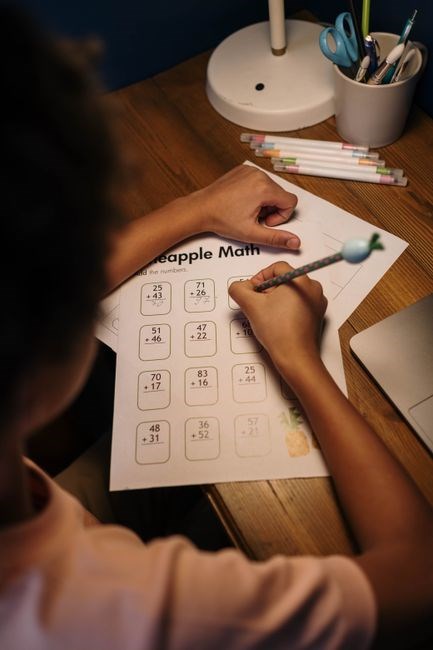
Understanding fractions involves recognizing numerators and denominators, how they represent parts of a whole, and the rules that govern their comparison. Mastery of these fundamentals enables students to solve worksheet problems confidently and apply concepts in real‑world contexts. Learn more. Explore OK

Least Common Denominator (LCD)
The least common denominator is the smallest number that each fraction’s denominator can divide into without remainder. It serves as a shared base, allowing fractions to be expressed with equal denominators so their numerators can be directly compared. To find the LCD, list the prime factors of each denominator, take the highest power of each prime that appears, and multiply these together. For example, for denominators 4 (2²) and 6 (2·3), the LCD is 12 (2²·3). Once the LCD is determined, each fraction is multiplied by a factor that turns its original denominator into the LCD, producing an equivalent fraction. This step ensures that the fractions are on the same scale, making the comparison of numerators straightforward. Mastering LCD calculation is essential for solving worksheet problems that involve comparing fractions with unlike denominators, and it also underpins addition, subtraction, and simplification of fractions in broader mathematical contexts; Practice with varied denominators reinforces the concept and builds confidence in handling more complex fraction operations. Students should practice converting fractions to LCDs using multiplication tables and visual fraction bars, which help solidify the concept. Additionally, reviewing common multiples and prime factorization strategies can reduce errors when determining the LCD. By mastering these techniques, learners gain a strong foundation for all subsequent fraction work, to and mor algebraic manipulation involving rational expressions.
Converting to Equivalent Fractions
To compare fractions with different denominators, each fraction is rewritten as an equivalent fraction whose denominator matches the least common denominator (LCD). This process involves multiplying both the numerator and the denominator by the same non‑zero factor. For instance, to convert 1/4 to a denominator of 12, multiply 1 by 3 and 4 by 3, yielding 3/12. Similarly, 2/3 becomes 8/12 by multiplying 2 and 3 by 4. The key is that the value of the fraction remains unchanged while its form adapts to a common base. Teachers often provide worksheets that ask students to perform these conversions step by step, encouraging the use of multiplication tables or prime factorization to determine the necessary multiplier. Practice with a variety of denominators—such as 5, 7, 9, and 10—helps students recognize patterns and reduces the cognitive load when solving comparison problems. In digital PDF worksheets, students can check their work instantly with answer keys, reinforcing the concept of equivalence and building confidence for more advanced fraction operations. Students benefit from visual aids like fraction bars or number lines, which illustrate how equivalent fractions occupy the same space on a common scale, making abstract concepts tangible. By repeatedly converting fractions to the LCD, learners internalize the relationship between numerators and denominators, which is essential for mastering addition, subtraction, and simplifying complex rational expressions; Teachers embed conversion steps into PDFs, letting students drag numerators onto a denominator grid!

Comparing Numerators After LCD
Once all fractions share the same denominator, the comparison reduces to a simple numerical comparison of the numerators. The fraction with the larger numerator is the larger fraction, while the smaller numerator indicates the smaller fraction. For example, after converting 3/8 and 5/12 to a common denominator of 24, we obtain 9/24 and 10/24; 10/24 is larger because 10 > 9. This principle extends to negative fractions and mixed numbers, where the sign of the numerator determines the overall magnitude; In worksheets, students are often asked to list the fractions in ascending order or to identify which fraction is greater or lesser. Teachers emphasize that the denominator’s role is to provide a shared scale, and once that scale is established, the numerators become the direct indicators of size. Practice problems in PDF format frequently include a mix of simple fractions, improper fractions, and mixed numbers to challenge students’ ability to convert and compare efficiently. By repeatedly applying this rule, learners develop a quick mental shortcut: “Same denominator, larger numerator wins.”
Students can also use visual fraction bars or number lines to see how the numerators compare on a shared scale. When fractions are expressed as decimals, the larger decimal value confirms the larger fraction. Students may also convert fractions to decimals to confirm comparisons quickly!! By practicing these steps, learners internalize a consistent strategy for fraction comparison across all contexts.

Worksheet Formats in PDF
PDF worksheets come in three main styles: basic comparison sheets, word‑problem sets, and assessment packs with answer keys. Each format offers graded difficulty, printable layouts, and instant feedback. Teachers can mix styles to match class needs and learning goals. Enjoy

Basic Comparison Worksheets
Basic comparison worksheets focus on ordering fractions with unlike denominators. Each sheet lists pairs like 3/7 vs. 5/9 and asks which is larger, smaller, or equal. The layout is simple: a heading, numbered problems, and space for the answer and reasoning. Teachers print the PDF for quick formative assessment or guided practice. Resources often include a short note on finding the least common denominator (LCD) before the problems, reinforcing the step of converting each fraction to an equivalent with a shared denominator. After completion, the PDF provides an answer key page showing the LCD, equivalent fractions, and the final comparison result. This immediate feedback helps students correct misconceptions. The worksheets are scalable: educators can add or remove rows to match the class’s pace or duplicate the PDF for a self‑check activity. Because the format is PDF, the content remains printable across devices. Overall, these worksheets reinforce the foundational concept of comparing fractions with unlike denominators.
Teachers can also use these worksheets to introduce the concept of common multiples and how they relate to LCDs. By working through several examples, students learn that the LCD is the smallest number that both denominators can divide into evenly. The worksheets may include a “find the LCD” mini‑exercise where students list multiples of each denominator until they find a match. This hands‑on activity reinforces procedural knowledge before moving on to comparison. The PDF format ensures all students receive the same layout and that the teacher can easily distribute or print the worksheets as needed. Students can review their work and discuss strategies in class daily.
Word Problem Worksheets
Word‑problem worksheets translate fraction comparison into real‑world scenarios. Each page presents a short narrative—such as sharing pizza slices, comparing distances, or allocating time—followed by a question that asks students to determine which fraction is larger. The PDF layout includes a space for the student to write the answer and a brief explanation of the steps taken. By embedding the LCD concept into everyday contexts, learners see the relevance of finding a common denominator before comparing numerators. The worksheets also feature a “hint” column that suggests listing multiples of each denominator to locate the LCD, guiding students toward systematic reasoning. After solving, the answer key page displays the full solution: the LCD, the equivalent fractions, and the final comparison, allowing instant self‑check. Teachers can use these sheets for group work, independent practice, or as exit tickets, ensuring that students grasp both the procedural steps and the underlying logic.
Students often find word problems engaging because they connect abstract fraction concepts to tangible situations. When solving, they practice identifying the common denominator, converting fractions, and then comparing numerators. Teachers can vary difficulty by using larger denominators or adding multiple steps, such as comparing three fractions or incorporating mixed numbers. The PDF format allows quick printing and sharing, and the answer key provides instant feedback, helping build confidence in fraction comparison skills.
Assessment Worksheets with Answer Keys
Assessment worksheets are designed to evaluate mastery of fraction comparison skills. Each sheet contains a series of problems that require students to find a least common denominator, convert fractions, and determine which is larger. The PDF format includes a clean layout with numbered questions, space for students to write their answers, and a separate answer key page that shows the step‑by‑step solution. Teachers can use these worksheets to grade quickly, identify misconceptions, and provide targeted feedback.
Key features of the assessment sheets include:
- Varied difficulty levels, from simple two‑fraction comparisons to multi‑step problems involving mixed numbers.
- Clear instructions that remind students to first find the LCD before comparing numerators.
- Answer key sections that illustrate the conversion process, the LCD found, the equivalent fractions, and the final comparison result.
- Optional “explain your reasoning” prompts to assess conceptual understanding.
Because the answer key is provided in the same PDF, teachers can distribute the worksheets to students, collect them, and then use the key for rapid grading. The key also serves as a study guide, allowing students to review mistakes and learn the correct approach. This dual‑purpose design makes the worksheets ideal for both formative assessment during lessons and summative assessment at the end of a unit.

Creating Your Own PDF Worksheet
Use free online tools like Canva or Google Docs to draft problems. Add fraction comparison tasks, then export as PDF. Customize fonts, colors, and borders for clarity. Save the file, share with students, and print for classroom use. Keep templates for future units
Selecting a Template Tool
Choosing the right template engine is the first step toward efficient worksheet creation. Look for platforms that offer pre‑designed layouts specifically for math drills, such as Canva, Google Docs, Microsoft Word, or LaTeX‑based editors. Key criteria include an intuitive drag‑and‑drop interface, built‑in fraction symbols, and the ability to embed equations via MathType or LaTeX syntax. Free tiers should support PDF export, while paid plans often add collaboration, version history, and cloud storage. Compatibility with learning management systems (LMS) such as Canvas or Google Classroom is a bonus, allowing direct upload of the finished PDF. Accessibility matters: choose tools that support screen readers, high‑contrast themes, and adjustable font sizes. Finally, consider community resources; many sites host ready‑made fraction‑comparison templates that can be cloned, customized, and saved for future reuse. By evaluating these factors, educators can streamline the worksheet‑design process and focus more time on instruction rather than formatting. This template tool offers flexibility and ease of use. This template tool offers flexibility and ease of use. This template tool offers flexibility and ease of use. This template tool offers flexibility and ease of use. This template tool offers flexibility and ease of use. This template tool offers flexibility and ease of use. This template tool offers flexibility and ease of use. This template tool offers flexibility and ease of use. This template tool offers flexibility and ease of use Extra.
Adding Fraction Problems

When designing a worksheet, the core lies in the problems themselves. Start by selecting a range of denominators that challenge students without overwhelming them—common choices include 2, 3, 4, 5, 6, 8, 9, 10, and 12. For each denominator, generate pairs of fractions that require the student to find a least common denominator (LCD) before comparison. For example, 1/4 vs 3/8, 2/3 vs 5/6, or 7/10 vs 3/5. Include both simple and slightly complex scenarios: some problems can be solved by direct comparison when numerators are already in proportion, while others demand the conversion step. To reinforce learning, vary the difficulty by adding mixed numbers or improper fractions, such as 5 1/6 vs 3 3/4. Provide a clear instruction set: “Find the LCD, rewrite each fraction, and determine which is larger.” Encourage students to show all intermediate steps; this practice builds procedural fluency. After the comparison, ask a follow‑up question that asks for the difference between the fractions, or for the fraction that is closer to a target value. This dual‑layer approach not only tests comparison skills but also deepens understanding of fraction size. By systematically varying denominators, fraction types, and follow‑up tasks, you create a balanced worksheet that supports mastery of comparing fractions with unlike denominators.
When generating problems, consider the students’ grade level: for elementary learners, keep denominators small and numerators simple; for middle school, introduce larger denominators and mixed numbers. Use random number generators or spreadsheet formulas to produce a diverse set of fractions automatically. Ensure that the LCD for each pair is not trivially the same as one of the denominators; this forces students to practice multiplication. For instance, pairing 2/9 with 5/12 requires an LCD of 36, encouraging multiplication skills. Additionally, embed real‑world contexts: “A recipe calls for 3/4 cup of sugar, while another uses 5/6 cup. Which recipe uses more sugar?” Such word problems make the activity engaging. Provide a column for students to write the LCD, the equivalent fractions, and the final comparison result. This structured format aids in self‑assessment. Finally, test the worksheet by solving a few problems yourself to confirm that the answers are correct and that the difficulty level is appropriate. Once satisfied, export the document as a PDF, ensuring that all fonts and symbols render correctly across devices. This PDF can then be printed or shared digitally with students or colleagues.

Exporting and Sharing PDF
After finalizing the worksheet, export it as a PDF by selecting “Save As” or “Export” in your word processor. Choose 300 dpi for print quality or 150 dpi for screen use, and enable “Optimize for Web” to keep the file size small. To protect the content, set a password or restrict editing permissions. Verify the PDF on desktop, tablet, and mobile to ensure fonts and tables display correctly. Share the file via email, attaching a brief assignment note, or upload it to a cloud service such as Google Drive, OneDrive, or Dropbox. Create a view‑only link and distribute it through Microsoft Teams, Slack, or an LMS, tagging it with relevant metadata so students can find it easily. For interactive grading, convert the PDF into a fillable form with Adobe Acrobat Pro or an online converter; students can submit answers directly within the document. Keep a backup on an external hard drive or a version‑controlled repository to restore the worksheet if needed. By following these exporting and sharing steps, every student receives a consistent, high‑quality resource regardless of their preferred device. Collaborate with peers by sharing the PDF link in a shared folder, enabling real‑time feedback and collective editing before final distribution. Ensure accessibility by including alt text for images and using high‑contrast colors; this makes the PDF usable for students with visual impairments. Finally, archive the PDF in a version‑controlled repository to preserve the original layout and allow future updates and keep format.
Leave a Reply